
 Bunlings: sprint apps for Jira



Refinement, minute twelve. Someone tries a joke, nobody laughs, and three cameras go dark. The meeting didn’t need less fun. It needed a different kind.
A forced icebreaker, a mandatory emoji round or a joke at a teammate’s expense makes it worse. The other kind is small: a moment that makes the scrum master smile and nobody wince.
What is the one rule for fun in agile meetings?
Put the humour in the situation, never in a person. Votes of 3 and 8 on the same work item are funny in a friendly way. “Our backend dev always votes 8” is not.
Before you add anything playful, run it past three quick tests. They are rules of thumb, not research.
- Is it about the work or the moment? If a person is the punchline, cut it.
- Can anyone skip it without anyone noticing? If not, it’s a rule wearing a party hat.
- Does it take seconds? A game that eats the refinement slot is a worse meeting with a theme.
Pass all three and you’re probably fine.
Which kinds of fun help, and which ones grate?
Fun helps when it is small, optional and about the work. It grates when it is mandatory, personal or long.
| Fun that helps | Fun that grates | |
|---|---|---|
| Opening | One work-safe question, a few words each, with a way to skip | Everyone on camera, one by one, sharing something personal |
| Reactions | A smile or “Let’s talk” after the cards open | Reactions nobody can turn off |
| Humour | A dry line when the votes nearly match (“So close.”) | Nicknames, or jokes about who always votes high |
| Sound | Off until someone chooses it | A fanfare that plays for the whole room |
| Look | A table look or card back the team picked | An animation that blocks the next step |
| Length | Seconds | Anything that needs its own agenda item |
How do you make sprint planning fun?
Use the moments the meeting already has, and add a little on top. None of these ask anyone to perform.
- Flip the cards together. Hidden votes that open at the same moment give you a tiny reveal, and nobody can copy the first number said out loud. If your team tends to drift toward whoever speaks first, estimation anti-patterns explains why.
- Let people react when the cards open. A smile, a “Let’s talk”, an “I’m convinced”. Someone can say “I’m not sure about that 8” without giving a speech.
- Use a dry line instead of a joke. A short line under the table when the votes land a card apart (“So close.”) does more than a forced gag, and it never names anyone.
- Keep a coffee card in the deck. Playing “Coffee break” is a polite way to say the room needs five minutes.
- Change the table now and then. A new table look and card back is a cheap refresh when the sprints start to feel the same.
Votes all over the place? Votes far apart in estimation covers what to say next.
How do you make a retro fun without making it silly?
Offer a warm-up, never require one, and keep the serious part serious. A retro is where people say what went badly. Fun there should lower the temperature a little, not hide the point.
- Open with one work-safe question. Keep answers anonymous and let anyone skip. Retro icebreakers that aren’t cringe has questions that stay about the sprint.
- Check the sprint weather. Everyone places the sprint somewhere between stormy and sunny, and nobody has to hunt for the right words. More in team health checks in retros.
- Say thanks privately. Public praise can feel like a performance. A line only the other person reads is just kind.
- Change the format. If the board has shown the same three columns for a year, a new shape is often the cheapest fun there is. Retro formats and when to use each helps you pick one.
To keep the rest of the session on time, see run a sprint retrospective in 45 minutes.
Why does fun need an off switch?
Because the same joke lands differently on different days and for different people. One person is having a rough sprint. Another sits in an open office and doesn’t want sound. Someone prefers less movement on screen. It’s 17:30 on a Friday.
Fun that can’t be turned down becomes one more thing to put up with. Fun with a switch stays fun for the people who want it.
What does this look like in Bunlings?
Small dumpling characters called Bunlings sit at the edge of the table and react to the vote. Everything playful can be turned down.
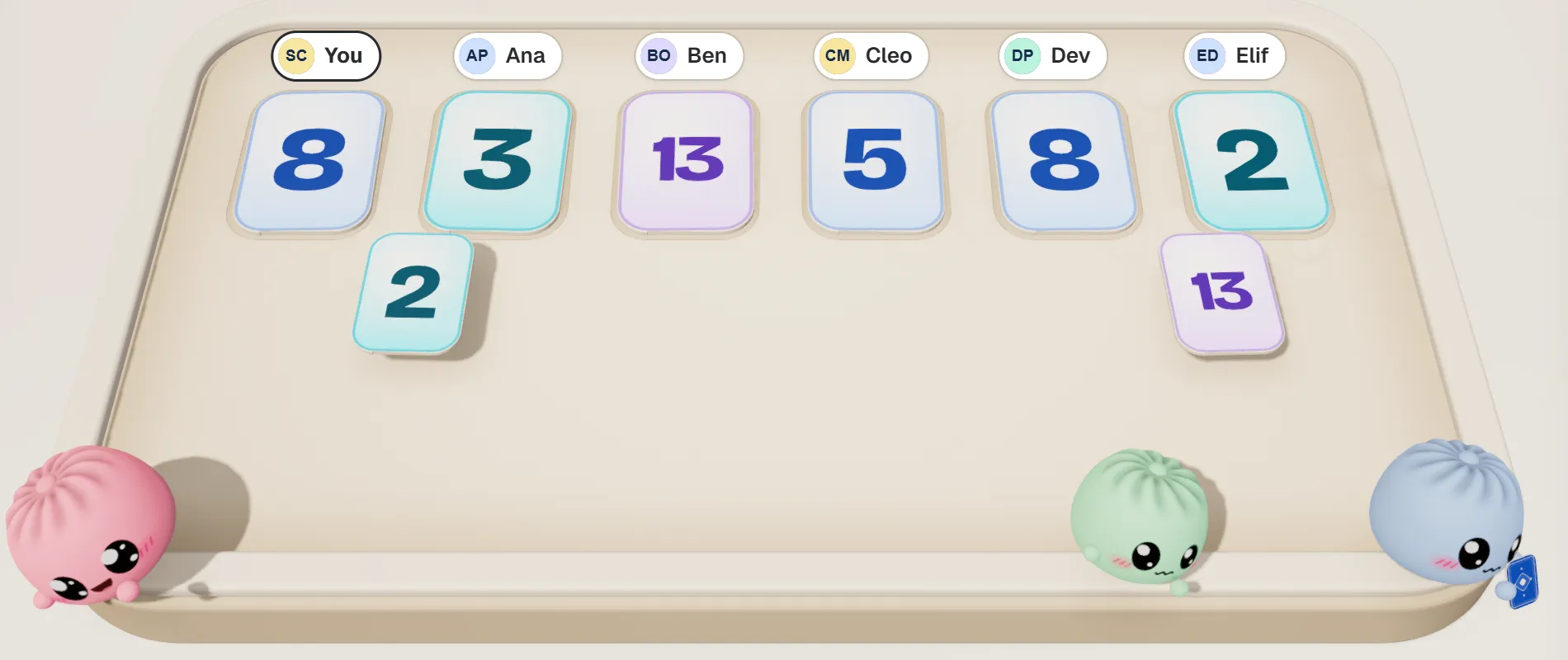
Votes from 2 to 13. The Bunlings look surprised, never cross. Sample team.
The Bunlings have thirteen moods, and none of them is ever sad or angry, even when the votes are far apart.
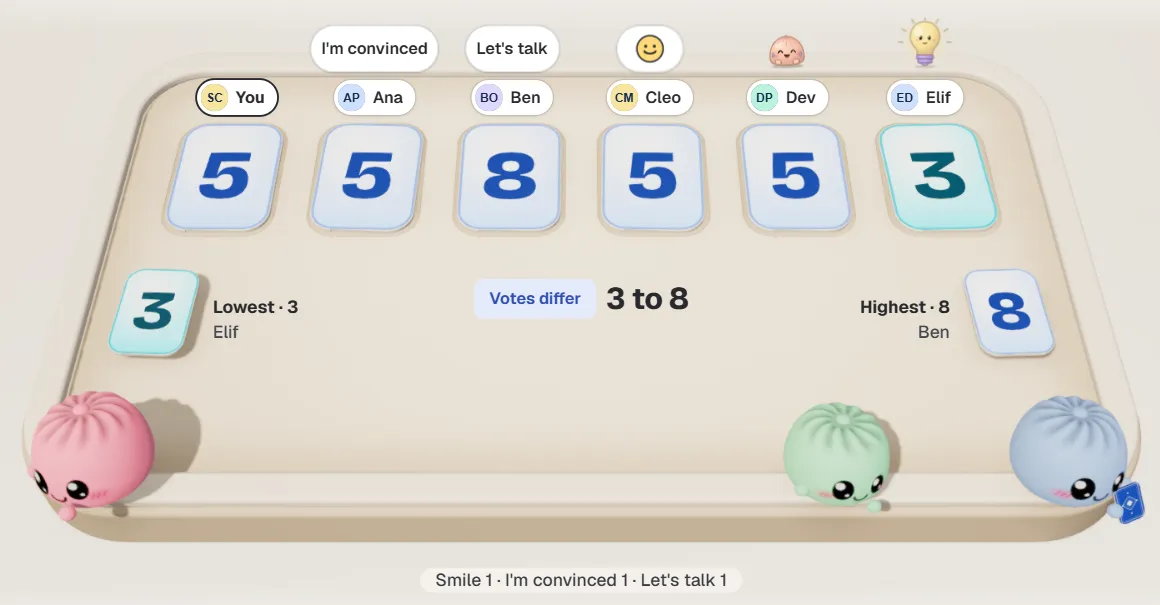
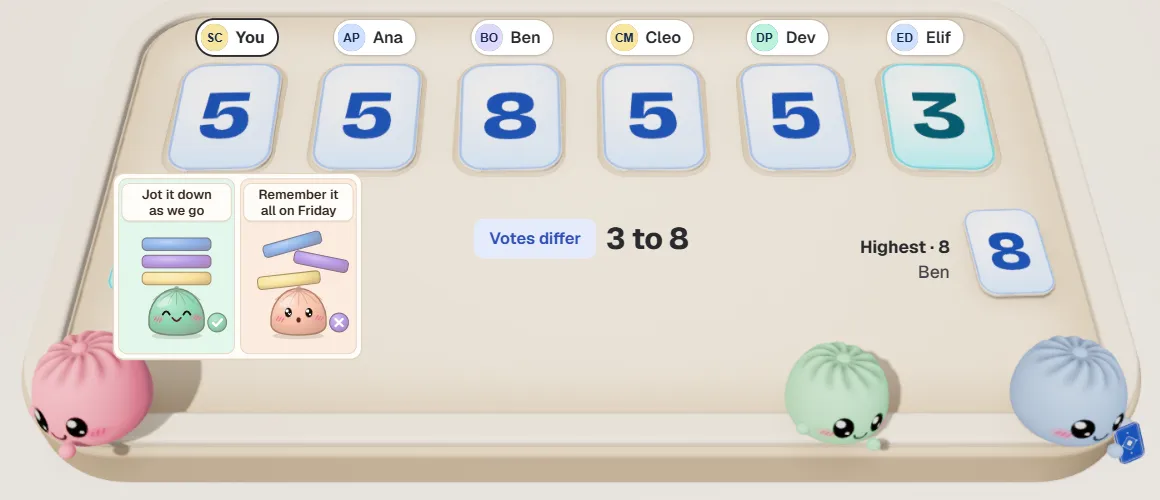
Votes from 3 to 8, and the team reacts: one “I’m convinced”, one “Let’s talk”, one smile. Sample team.
Twenty meme templates come with kind captions you can edit. Anyone can thank a teammate with a line only that person can read, and the person running the retro can switch kudos off. In a retro, the icebreaker comes from 30 work-safe questions, with Skip for anyone who passes.
A meme about the sprint, never about a person. Sample team.
How do you turn the fun down or off in Bunlings?
Each person can turn it down on their own screen, and admins can start everyone calm. Nobody has to ask.
| Switch | What it does | Who sets it |
|---|---|---|
| Calm for me | Turns off the Bunlings, reactions, motion and sound on your screen | Each person |
| Bunlings, Reactions, Sound | Turn each one off by itself. Sound starts off | Each person |
| Motion | Follow my computer, On or Off, or choose each animation | Each person |
| Calm by default | Starts everyone calm. People can switch playful on for themselves later | Admins |
| More fun | One switch that adds seven extras. Off until you turn it on | Set in Room options, for the whole table |
A calm screen next to a playful one is normal, and nobody has to explain it.
When should you skip the fun entirely?
When the mood doesn’t call for it. Run the meeting plain after an incident, after bad news, after a sprint that went badly, or when people are tired and just want to finish.
And if a meeting is dull because it has no clear purpose, give it a shorter agenda before you give it stickers. No amount of fun rescues a meeting nobody needed.
Try Bunlings in your Jira
Your next sprint, estimated together, with the fun turned up or down by each person. Install Bunlings from the Atlassian Marketplace, open the menu on a sprint, and the room is already there. It runs on Jira Cloud, with no new login and no calls to outside servers, in ten languages. It is free for up to 10 users, then from $2.00 per user per month.
- Bunlings on the Atlassian Marketplace
- Watch the demo
- See Bunlings: scrum poker and retros inside Jira
Weighing it against what Jira does on its own? Read native Jira vs Bunlings.