
 Bunlings: sprint apps for Jira





Went well, could be better, try next. Fortieth sprint in a row. The cards are the same cards, and everyone knows it.
A retro format is just the set of columns the team writes into. Change the columns and you change the questions, and the questions decide what people notice. This page sorts 15 formats by the situation they fit, so you can pick one in a minute instead of defaulting to the old one.
Which retro format should you use?
Choose by what the last sprint was like, not by what sounds fun. Three situations cover most sprints:
- Quick: short on time, a new team, or a calm sprint with nothing to untangle.
- Feelings: a hard sprint, a tense one, or a team that has gone quiet.
- Improve: you want to leave with a concrete change to how you work.
Here are 15 formats, five per situation. You can run any of them on a whiteboard.
Quick
| Format | Columns | Use it when |
|---|---|---|
| Keep and change | Keep, Change | The team is new to retros |
| Plus and delta | Plus, Delta | You want to repeat and change in two words |
| One word check | My word, Why | Time is short and you need a pulse |
| What went well, what did not | What went well, What did not | You want two plain columns, nothing to explain |
| Start, stop, continue | Start, Stop, Continue | You want clear decisions |
Feelings
| Format | Columns | Use it when |
|---|---|---|
| Mad, sad, glad | Mad, Sad, Glad | The sprint had real ups and downs |
| Rose, bud, thorn | Rose, Bud, Thorn | You want a gentler tone |
| Hopes and fears | Hopes, Fears | A big piece of work is coming |
| Energy givers and drainers | Gave energy, Drained energy, Restore it | People look tired |
| Calm after a hard sprint | What we carried, What helped, Rest and repair, Gentle next step | The sprint took a lot out of everyone |
Improve
| Format | Columns | Use it when |
|---|---|---|
| Drop, add, keep, improve | Drop, Add, Keep, Improve | You want to decide what changes |
| Starfish | Keep doing, Less of, More of, Start doing, Stop doing | You want to fine-tune habits |
| What slowed us down | Slowed us down, Sped us up, Remove first | Work kept getting stuck |
| Plan versus reality | We planned, What happened, Why it differed, Plan better | The sprint did not go as planned |
| Handoffs and waiting | Where we waited, What unblocked us, Unclear handoffs, Make it smoother | Work items sat idle between people |
What is the fastest retro format?
One word check or Keep and change. Both ask very little, so they finish fast.
One word check works as an opener, or as the whole retro when the sprint was uneventful. Everyone writes one word for the sprint and a short reason, so it takes a few minutes to write and a few more to read. Expect at least one “fine.” Read the Why column.
Keep and change suits a team running its first retro, because nobody has to learn a method before they can say what they think.
Plus and delta is the same idea in two short words. If your team already says delta in standups, this one needs no explaining.
What went well, what did not has no third column for ideas, so the talk stays on the sprint you just had. Add the ideas in the actions step.
Start, stop, continue makes every card an instruction: something to begin, end or keep. A short retro gets clear decisions out of it.
A quick format does not mean a thin retro. It means fewer columns, so cards are easier to group and the vote is short. Keep the actions step, because even a quick retro should end with a change someone owns.
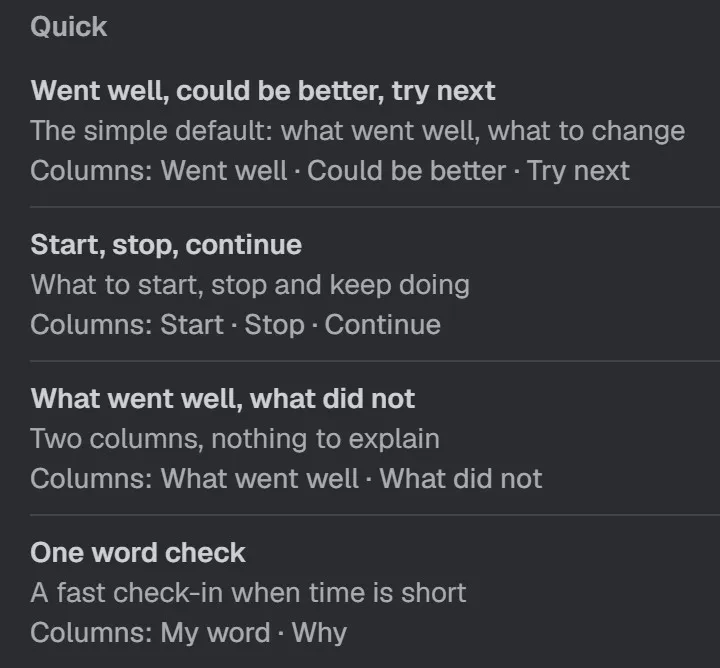
The Quick group in Bunlings starts with the classic “Went well, could be better, try next”. Each format shows its columns before you pick it.
Which retro format works after a hard sprint?
Rose, bud, thorn or Calm after a hard sprint. Both start from how people felt, not from what went wrong.
Rose, bud, thorn: the bud column is the clever one. It gives people a place for things that are not working yet, but might, and that keeps the retro from splitting into good and bad.
Mad, sad, glad is more direct. It works when the sprint had real feelings in it, such as a release that slipped or a teammate who left. It also works for lighter sprints, because “glad” is easy to fill in.
Calm after a hard sprint is for the sprint that took a lot out of the team. It does not ask for five improvements. It asks for one small, kind change.
Energy givers and drainers is for the team that looks tired and has not said so. It gives the tiredness a column, so nobody has to raise a hand. It pairs well with a regular team health check.
Hopes and fears suits the sprint before something big. Fear is easier to say when it has its own column.
A rule for all of these: let people write cards before anyone talks, and keep the cards hidden until everyone has finished. A quiet teammate will write “worried” long before they say it out loud. It matters even more when half the team is on a call: see remote and hybrid retros. For the order of the steps, see a retro in 45 minutes.
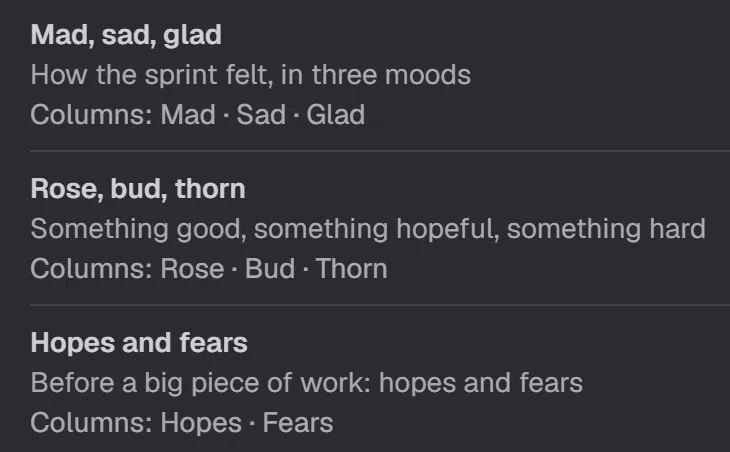
Part of the Feelings group. The hint for Rose, bud, thorn says it all: something good, something hopeful, something hard.
Which retro format gives you real changes?
The Improve formats, because their columns ask for decisions and changes, not only for opinions.
Drop, add, keep, improve: each column is a verb, so the talk goes straight to what to do.
Starfish: the “less of” and “more of” columns are the useful ones. Most habits are not worth stopping or starting. They are worth turning up or down. A retro card rarely kills the standup. It can easily make it shorter.
What slowed us down: use it when work kept getting stuck. The hint under “Remove first” is “Biggest drag, easiest to fix”, which keeps the talk on one change.
Plan versus reality: the hint under “Why it differed” is “Causes, not people”, which is a good rule for the whole conversation. It fits a sprint where the plan and the outcome drifted apart.
Handoffs and waiting is for the sprint where work items spent more time waiting than moving. Start with the Unclear handoffs column: that is where the fix usually hides.
Whatever you pick, keep the same ending. One or two actions, each with an owner, each somewhere the team will see it again. The format shapes the talk. The follow-through is what makes a retro worth running. There is more on that in retro action items that get done.
How often should you change the retro format?
When the cards start to repeat. If three sprints in a row produce the same cards under the same columns, the format has stopped asking new questions.
Some teams rotate on a schedule, for example a new format every sprint or every other sprint. Others switch when something happens: a release, an incident, a new team member. Both work. What does not work is picking a format for novelty and ignoring what the sprint was like.
A simple pattern:
- Keep a plain format as your home base. Yes, “Went well, could be better, try next” is fine, as long as it is not the only one you ever use.
- After a hard sprint, use a Feelings format.
- After a sprint where the plan fell apart, use an Improve format built for it, such as Plan versus reality.
- When the team is bored, try something lighter. Sailboat (Wind, Anchors, Rocks, Island) is a classic light one. For a warm-up, see icebreakers that are not cringe.
Do not change the format and the agenda in the same sprint. If the team has to learn new columns and new steps at once, the retro will be about the retro.
What if none of these fit?
Change the columns. A format is only a starting set of questions, so keep the ones that work and swap the one that does not.
A blameless look at an incident needs different columns than a look back at a calm sprint. Before you invent your own, look for a format built for the moment, such as an incident review or an after-release look back.
Where does Bunlings fit in?
Bunlings runs the retro inside Jira. Open the menu on a sprint and choose Open sprint retro. It comes with 50 formats. Besides Quick, Feelings and Improve, it has a Playful group, and formats for specific moments such as After a release and Incident review. You can switch format without losing a card, and the actions you agree become Jira work items in two clicks.
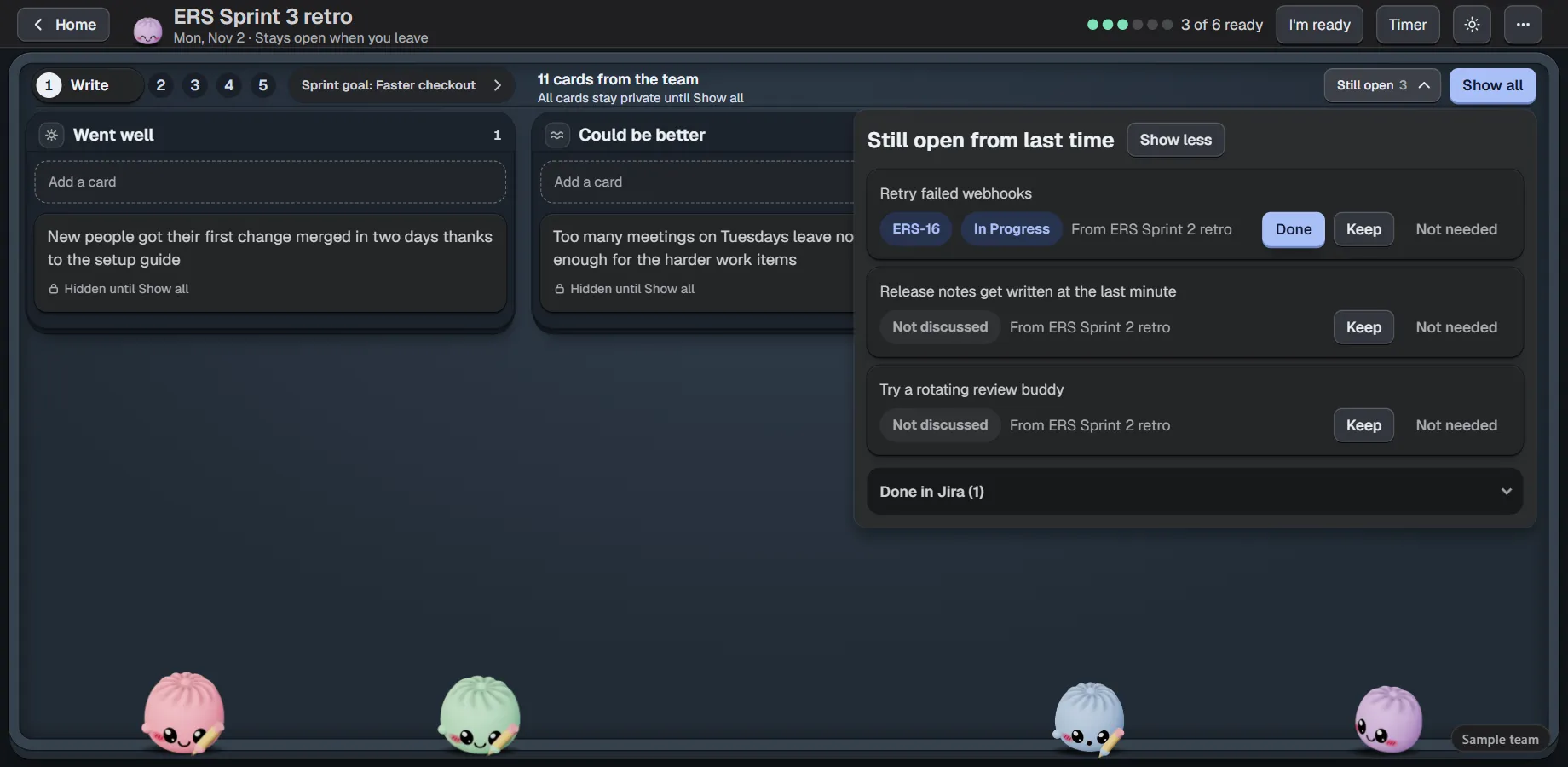
A sample team mid-retro. The cards stay hidden until Show all, and last retro’s actions come back to be closed or kept.
To switch, open the retro, then Retro options, then Format (only the person who started the retro can change it). Pick one of the Common formats, or open More formats and search by name, column or situation. Type “tired” and it finds Energy givers and drainers.
Free for up to 10 users, then from $2.00 per user a month. Runs on Jira Cloud, in 10 languages.