
 Bunlings: sprint apps for Jira





Refinement, work item four of twelve. The scrum master reads it out. Someone says, “Feels like an 8.” Nobody says anything for a second. Then five people nod, and five people say 8.
Was it an 8? Nobody knows, because nobody else got to decide. That second of silence is anchoring. Here is how to spot it and what to change at your next refinement.
What is anchoring bias in estimation?
Anchoring bias is the pull of the first number. Once a number is on the table, later estimates drift towards it, even when people think they are judging for themselves.
Psychologists described the effect in the 1970s, and it has turned up in study after study since, software estimates included. In a team the effect is simple to picture. The first number becomes the question: nobody asks “how big is this?” any more, they ask “is this an 8?”
The number does not have to come from a person. A deadline in the work item title, an old estimate pasted in the description, a customer who “only needs a small tweak”: all of them are anchors.
Why do teams keep doing it?
Because it feels like being efficient. Someone offers a number, the room agrees, the next work item comes up. The meeting ends early and everyone feels good.
It also feels polite. Disagreeing with a number takes a little courage. Agreeing takes none.
And it hides itself. A room full of 8s looks like agreement. Only the person who privately thought 3 knows it was not.
Which estimation anti-patterns should you watch for?
Anchoring is the headline, but it has relatives. Here are the common ones, how to spot each, and the fix.
| Anti-pattern | The sign | The fix |
|---|---|---|
| The first number | Someone speaks before the cards are down, and the room lands within one step of it | Votes stay private until the reveal. Nobody says a number before it |
| The loudest voice | The same person’s number wins most weeks | Reveal together, so a number carries no volume. Ask the quietest person first |
| The senior number | Votes arrive one by one and bend towards the lead’s | The lead votes with everyone else, or watches without voting |
| The echo | The last work item was a 5, so this one is a 5 too | Vote on this work item alone. Glance at how long past work with that estimate actually took |
| The pressure vote | “Let’s vote again until we agree” | One more vote after talking. If the gap stays, split the work item |
| The loaded title | A date or an old number sits in the work item text | Read the work item aloud without the numbers. Vote on the work, not the target |
None of these are about bad people. They are about a room doing what rooms do.
How do hidden votes fix anchoring?
Everyone picks a card face down. The cards are turned over at the same moment. Nobody has seen anybody else’s number, so nobody could bend towards it.
That one habit covers the first number, the loudest voice and the senior number in one go. It is the whole idea behind scrum poker, and it is why the cards exist at all.
You can do it with paper cards, or with fingers held up on a count of three. It works wherever everyone can commit before they see. It breaks the moment someone peeks.
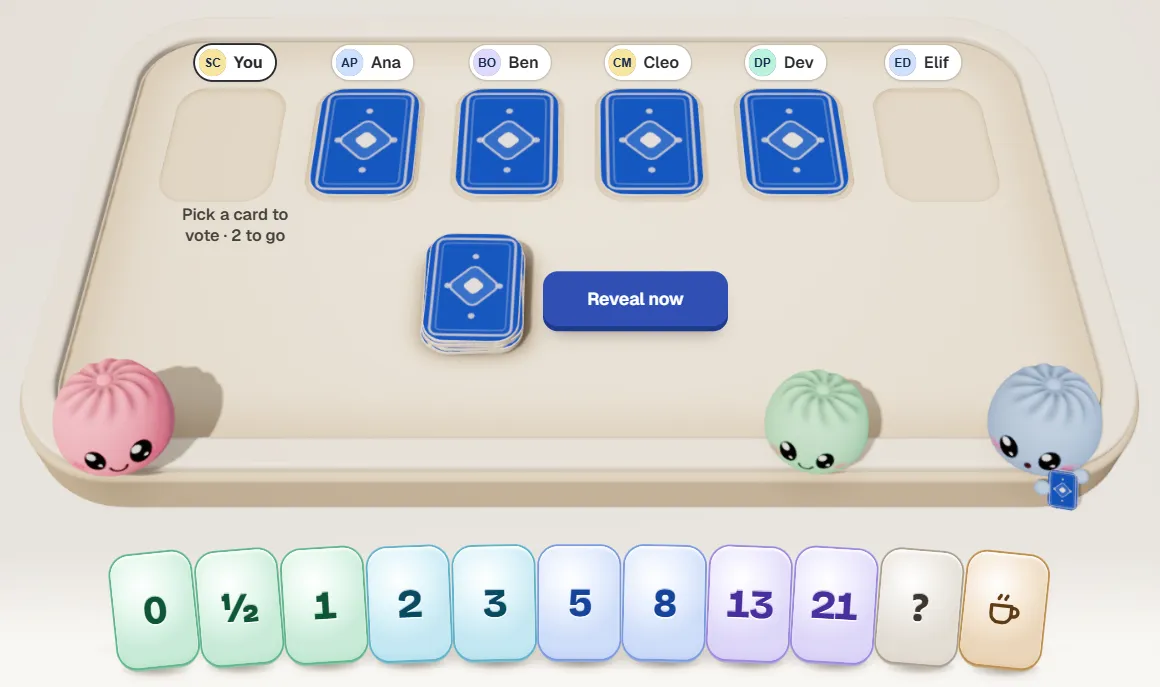
Before the reveal: 4 of 6 voted, and nobody can see what the others picked. Sample team, not real data.
What happens after the reveal?
Anchoring does not end at the reveal. It moves. Once the cards are up, people can see the pile of 5s and feel the pull towards it.
So the order of talking matters. Do this:
- Look at the spread first. All the same? Agree and move on. Mixed? Keep going.
- Ask the outliers first. The lowest card and the highest card, one after the other. “What are you picturing?” works better than “why did you say that?”
- Let the majority go last. The 5s have the least to add. They already agree.
- Vote again once if the talk changed anything.
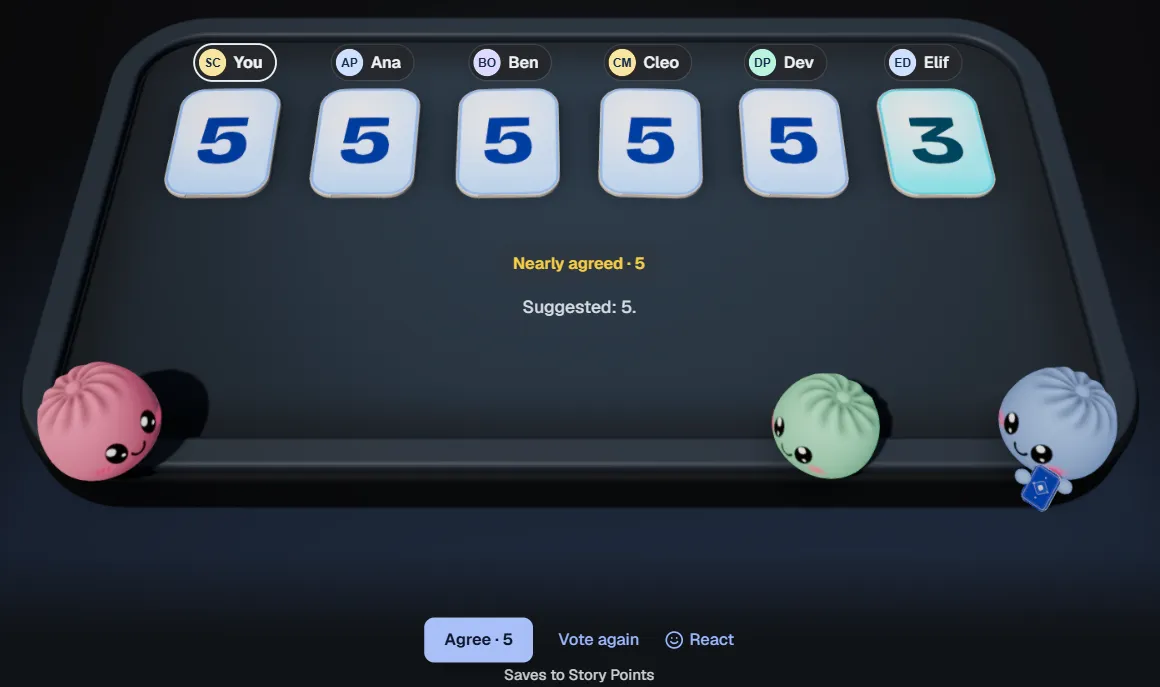
After the reveal: five 5s and a 3. Ask the 3 first. Sample team, not real data.
A lone 3 among five 5s is not noise. It might be the person who knows something. Votes 3 and 13 covers what to do with a wide gap.
Can you avoid anchoring without a meeting?
Yes. Hidden votes are the point, and nobody needs to share a room.
The usual trap is the comment thread. Someone writes “8” under the work item. In Jira a comment is usually visible to everyone who can see the work item, so the next person reads that 8 before they have formed a view. That is anchoring with a timestamp.
The plain fix: ask everyone to send their number privately to one person, who posts all of them together. It works. It is also a bit of a chore, and the person doing it becomes a spreadsheet. Estimating without a meeting goes through the steps.
What can hidden votes not fix?
Hidden votes stop one anchor: the number somebody said. They do not stop the others.
- Anchors in the work item. A deadline in the title still pulls. Fix the text, not the cards.
- Pressure outside the room. If a manager says “this is two days”, nobody votes freely, hidden or not.
- Everyone is sure and wrong. A room can agree in private and be mistaken together. That is where looking back helps. Why estimates are off covers it.
- Habit. If the reveal is followed by the senior person speaking first, you have rebuilt the problem one step later.
No app fixes pressure or habit. A good scrum master does.
Can a Jira app keep votes hidden for you?
In Bunlings, hidden votes are how the room works. Everyone sees “4 of 6 voted”, nobody sees a number until the cards flip together, and a lead who would rather not tip the room can press Watch without voting. When the room agrees, Agree saves the number to your board’s estimate field, as you, with 10 seconds to undo.
What should you try at your next refinement?
Pick one of these per refinement. Start with the first.
- No number before the reveal. Not “probably an 8”. Not “that’s a small one”.
- Everyone commits first. Cards, fingers or an app, as long as nobody peeks.
- Outliers talk first after the cards turn.
- Let the lead vote like everyone else, or watch without voting.
- One re-vote, then decide. Agree or split.
- Check the title. Strip dates and old numbers before you read it out.
Then, at the retro, ask one question: “Did anyone feel pulled by a number this sprint?” It costs a minute, and the quiet 3 from week one finally gets to say so.
Try it in your next refinement
Bunlings runs inside Jira Cloud, with no outside servers and no new login. It is free for up to 10 users.
Sources
- Tversky and Kahneman, “Judgment under Uncertainty: Heuristics and Biases”, Science, 1974: the original description of anchoring and adjustment.
- Aranda and Easterbrook, “Anchoring and Adjustment in Software Estimation”, 2005: anchoring shown in software estimates.