

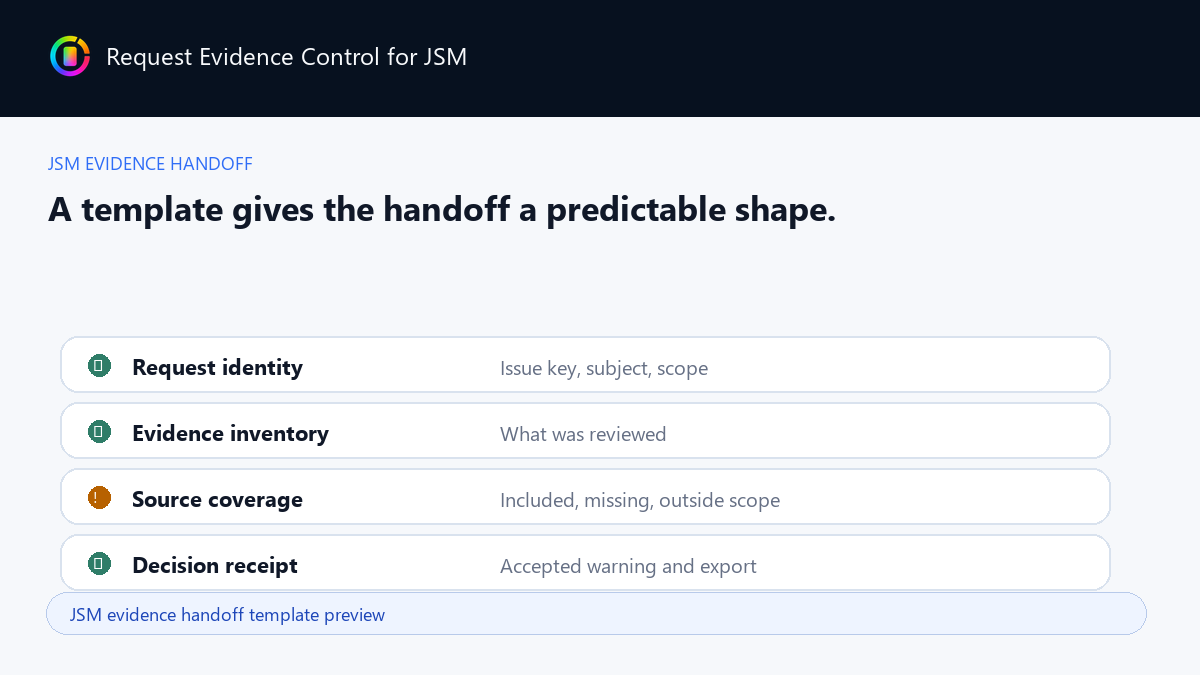
A JSM evidence handoff template should name the request, subject, reviewed sources, source status, missing evidence, accepted caveats, receipt, and manifest. The template helps the next reviewer understand the handoff without rebuilding the ticket from comments.
Use this guide to choose the right next step.
Turn the JSM request into a review-ready handoff
If a closed request may need to explain what was reviewed later, use Request Evidence Control to preserve the receipt, manifest, source status, and visible limitations in one evidence pack.

What the native JSM record usually gives you
In a service request that needs a reusable handoff format before it leaves the active queue, the native JSM record is still the starting point. It can show request fields, comments, approvals, attachments, and activity history, and that context matters. A careful reviewer should not ignore the ticket just because a separate evidence pack exists. The ticket is the source of the work item, the people involved, and the timeline that explains why the review happened.
The problem begins when the ticket is asked to answer a second kind of question. A workflow record can show that work moved from one state to another, but later review usually asks how the decision was supported. That difference sounds small during the live request and becomes much larger when someone reads the record weeks later.
Where the review story becomes hard to reuse
The common weak spot in this scenario is that the request has useful records but no stable handoff structure. That does not mean the JSM request is useless or that the team did nothing wrong. It means the final handoff needs to say where the evidence boundary was, so the record does not look stronger than the review actually was.
The risky move is making every handoff depend on how one admin wrote the ticket that day. It creates a clean-looking closure while leaving the next person who needs to read the record without interviewing the admin to reconstruct which evidence was reviewed, which caveat mattered, and whether the final decision included a known limitation. That reconstruction is slow, and it can easily change depending on who is reading the comments.

What the handoff needs to preserve
A stronger handoff preserves a template-backed handoff with source status and caveats in predictable places. It does not need to pretend every source was complete. It needs to make the review boundary visible enough that the next reader can tell the difference between proved evidence, partial evidence, and evidence that was not available from the collected sources.
That is why the useful unit is not a screenshot, a comment, or an attachment by itself. The useful unit is a packet with a stable receipt, a manifest of what it contains, clear source status, and the limitations that affected the decision. Each part answers a different reviewer question.
| Question | What to capture | Why it matters |
|---|---|---|
| What was reviewed? | Evidence groups and source names | Prevents a vague claim of review. |
| What was missing? | Source status and caveat text | Keeps weak coverage visible. |
| Who accepted it? | Decision receipt and timestamp | Shows the final handoff state. |

A practical workflow to use inside JSM
Start with the request while it is still fresh. Confirm the subject, the issue key, the request type, and the scope of the review. Then separate task completion from evidence review. A task can be done even when one evidence source is weak, but the final record should not hide that distinction.
Next, inspect the source status before exporting. If a source is included, say so. If it is still collecting, outside scope, or missing, say that as well. If a warning is accepted, record the warning as part of the handoff. Then export the packet after the decision, not before the limitation has been handled.
- Confirm the exact JSM request and subject before collecting evidence.
- Review source status separately from workflow status.
- Resolve blockers when possible; accept limitations only when the limitation is visible.
- Export the receipt, manifest, source status, and caveats together.
Language that makes the record easier to review
Write the record so the next person who needs to read the record without interviewing the admin can read the limitation without guessing your intent. A useful sentence names the source, the status, and the decision impact. For example, say that the source was outside the current collection scope and that the handoff was accepted with the warning included. Avoid broad phrases that sound clean but do not explain the boundary.
The language should also separate facts from decisions. A fact might be that a source was included, missing, or outside scope. A decision might be that the admin accepted the warning and delivered the pack anyway. Keeping those two layers separate helps a later reader understand what the evidence showed and what the team chose to do with it.
- Name the exact missing or limited source.
- State whether the source was missing, collecting, included, or outside scope.
- Say whether the limitation blocked delivery or was accepted with a warning.
- Keep the caveat in the final packet instead of only in a comment.
The readback test before you call the handoff ready
Before the packet is treated as ready, test whether a reviewer could read it back in plain language. They should be able to say which request was reviewed, which evidence groups were included, which source created the warning, and why the final packet was still delivered. If that readback is not possible, the handoff is still too dependent on the original admin.
The readback test is especially useful when the request has useful records but no stable handoff structure. It prevents the record from sounding stronger than it is. It also protects the team from a different problem: making the packet so cautious that nobody can tell what was actually reviewed. The best handoff is clear about both sides.
Implementation notes for teams using JSM
Keep the evidence workflow close to the request that triggered it. If the evidence review lives too far away from the JSM issue, the connection between request, subject, limitation, and export weakens. The request should remain the anchor even when the evidence packet becomes the artifact the reviewer reads.
Also decide who is allowed to accept a constrained handoff. The answer may differ by request type, risk level, or team policy. The important part is that acceptance is explicit. A visible acceptance step is easier to explain later than a quiet export that leaves the warning behind.
When the native record may be enough
Not every request needs a separate evidence pack. If the question is low risk, the evidence is simple, and nobody expects the record to be read outside the live ticket, native JSM context may be enough. The separate packet becomes more useful when the request crosses teams, includes partial evidence, or may be reviewed after the admin who handled it has moved on.
That boundary matters because the goal is not to add ceremony to every ticket. The goal is to avoid weak handoffs when the later question is predictable. If the team already knows someone may ask what was reviewed, what was missing, and what was accepted, the evidence structure should be created before that question arrives.

Where Request Evidence Control for JSM fits
Request Evidence Control is built for the second layer of the problem: the handoff after a JSM request needs evidence context. It opens from the JSM request, tracks the review as an evidence pack, keeps source status visible, and carries accepted limitations into the export instead of letting them disappear behind a clean status.
For this topic, the useful outcome is a template-backed handoff with source status and caveats in predictable places. The product does not need to replace the JSM ticket. It helps the ticket become reviewable by giving the evidence boundary a defined shape and by making the export easier to read later.
JSM evidence handoff template sections
Use the checklist below as a practical review aid. It is intentionally narrow: it keeps attention on what a later reviewer needs to understand rather than trying to turn the JSM request into a universal archive.
| Area | Include | Review purpose |
|---|---|---|
| Request | Issue key, request type, subject | Anchors the handoff. |
| Reviewed evidence | Evidence groups and source names | Shows what was checked. |
| Limitations | Missing records and caveats | Preserves weak spots. |
| Receipt | Decision and export time | Shows the final state. |
FAQ
Is the native JSM ticket still useful? Yes. The ticket is the work record and should remain the anchor. The evidence pack adds structure around request fields, comments, approvals, attachments, and activity history when the later review needs a clearer handoff.
Does missing evidence mean the request cannot be closed? Not always. If the request has useful records but no stable handoff structure, the team may still accept a constrained handoff, but the limitation should be visible in the exported record.
Should every offboarding or access request get a full packet? Usually no. The packet is most useful when the request may be reviewed later, when evidence coverage is partial, or when the final decision needs to survive outside the live queue.
What should the final reader be able to tell? They should be able to see the request, what was reviewed, what was missing, what was accepted, and why the packet was delivered to the next person who needs to read the record without interviewing the admin.