When spreadsheets are enough
Early segmentation, small batches, and one-person reviews where no durable approval trail is expected afterward.
Spreadsheets are fine for listing accounts. They are weak at showing why each seat is still billable, which rows should be held out, and how to preserve the proof after action.
Exports and sheets are useful early. License Guard earns its place when the team needs billable-path explanation, explicit lane logic, approval, and proof that survives after the cleanup cycle.
Decision rule: use spreadsheets for raw inventory and rough segmentation. Use License Guard when approval, exceptions, and proof must stay attached to the same review instead of getting rebuilt in email and side notes.
| Question | Exports and spreadsheets | License Guard |
|---|---|---|
| Why is the seat still billable? | Often answered outside the spreadsheet | Shown inside the review workflow through the billable path |
| Can mixed row types be split into lanes? | Usually manual tabs or color codes | Ready, owner-review, and held-out rows stay explicit |
| Can risky rows be held out explicitly? | Usually handled in side notes | Protected exceptions and held-out rows in the same review surface |
| Does proof stay tied to the cycle? | Usually reconstructed from exports and email | Approval, cleanup, and proof stay linked |
| Does finance get a stable explanation? | Only if the admin rebuilds the story | Yes, because the lane logic and proof stay attached |
| Does the tool stay inside the cleanup boundary? | No defined product boundary | Yes. It does not replace SCIM or delete Atlassian accounts. |
Early segmentation, small batches, and one-person reviews where no durable approval trail is expected afterward.
Mixed row types, copy drift, side-note exceptions, and finance or audit questions that reopen the whole batch.
A stale row is only a symptom. The decision needs the path that still makes the seat billable and the right lane for that row type.
Use spreadsheets for inventory. Use License Guard when the team needs approval, exceptions, and proof without rebuilding the story later.
A spreadsheet can hold every row in one place. That does not mean every row belongs in one decision process. The useful question is what kind of row this is and whether the current batch should act on it now.
| Row type | How it looks in a spreadsheet | Why the cleanup stalls | What a focused workflow changes |
|---|---|---|---|
| Clearly stale human | Just another line in the export | No one knows whether the path still makes the seat billable | The billable path is reviewed before approval |
| Needs manager confirmation | Color-coded note or side comment | The owner decision lives outside the review | Owner-review rows stay in a visible lane |
| App or service identity | Looks like another inactive account | Non-human rows contaminate the human cleanup batch | Exception rows stay held out deliberately |
| Externally managed row | Still present in the export | The local admin cannot resolve it cleanly anyway | The workflow records the route-out instead of faking certainty |
The renewal meeting rarely stops at "how many rows look stale?" The next questions are harder: which rows were actually approved, which were held out deliberately, and why should anyone trust the savings number next month when the export has already changed? Those are handoff questions, not filtering questions.
A governed workflow changes that by keeping the billable path, the lane decision, and the resulting proof in one cycle record. That is what turns a cleanup pass into something finance can sign off on without forcing the admin to narrate the spreadsheet live every time.
This is also where spreadsheet-based workflows become commercially awkward. The file may still be technically correct, but the organization is buying more meetings, more clarification, and more rework every time the cleanup story has to be retold.
A sheet can list rows, but it does not automatically preserve which rows were ready, which were held out, and why the savings number should be trusted. That proof burden is where finance conversations usually reopen manual cleanup.
If the renewal conversation still needs the hidden-cost framing first, the companion article How to Find Hidden Jira License Waste Before Renewal sets up the billable-path problem before this page asks the buyer to choose a workflow.
This distinction matters because many renewal reviews stall when teams jump from a spreadsheet directly to broad identity-tool claims. Provisioning, IdP policy, and lifecycle orchestration are adjacent problems. They do not remove the need for one governed review that separates actionable humans from exceptions, records approval, and leaves proof behind.
That narrower boundary is part of the product argument. A focused workflow is easier to believe because it does not claim to fix every access problem in Atlassian Cloud. It claims to make renewal cleanup review more explainable, more approvable, and easier to defend later.
No. They are useful for early inventory and quick segmentation. They become fragile when approval, exceptions, and proof need to stay attached to the same cleanup workflow.
Because a stale row alone does not explain why the seat still costs money or whether the row belongs in the current cleanup lane.
App accounts, service identities, externally managed rows, and users awaiting owner confirmation usually need a separate exception lane.
When the bottleneck is no longer visibility of rows but explainable review, approval, and proof after the cleanup cycle.
After the table, the next useful move is usually the product page, the renewal use case, the proof artifact, or the article that explains why spreadsheet cleanup keeps stalling under approval pressure.
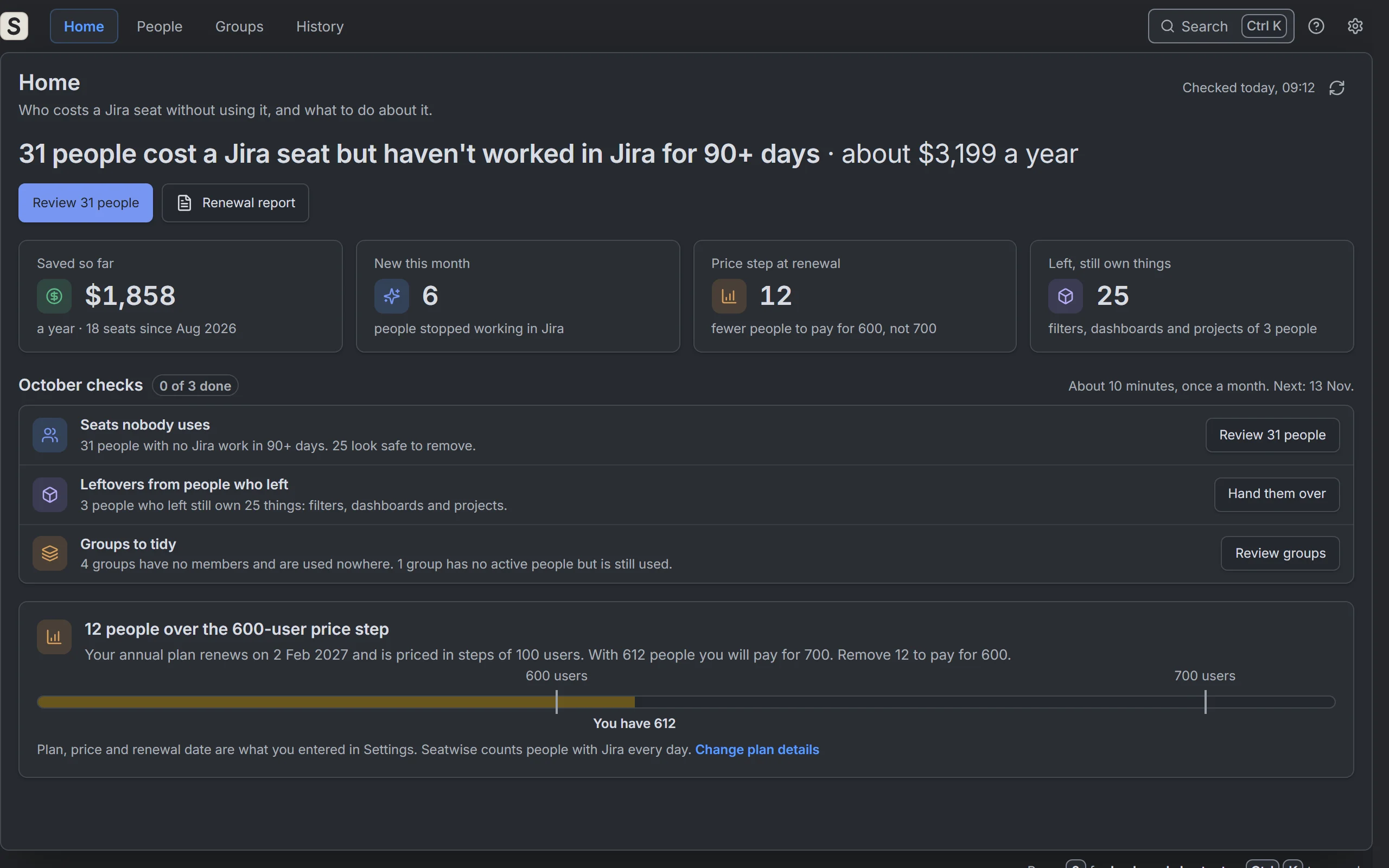
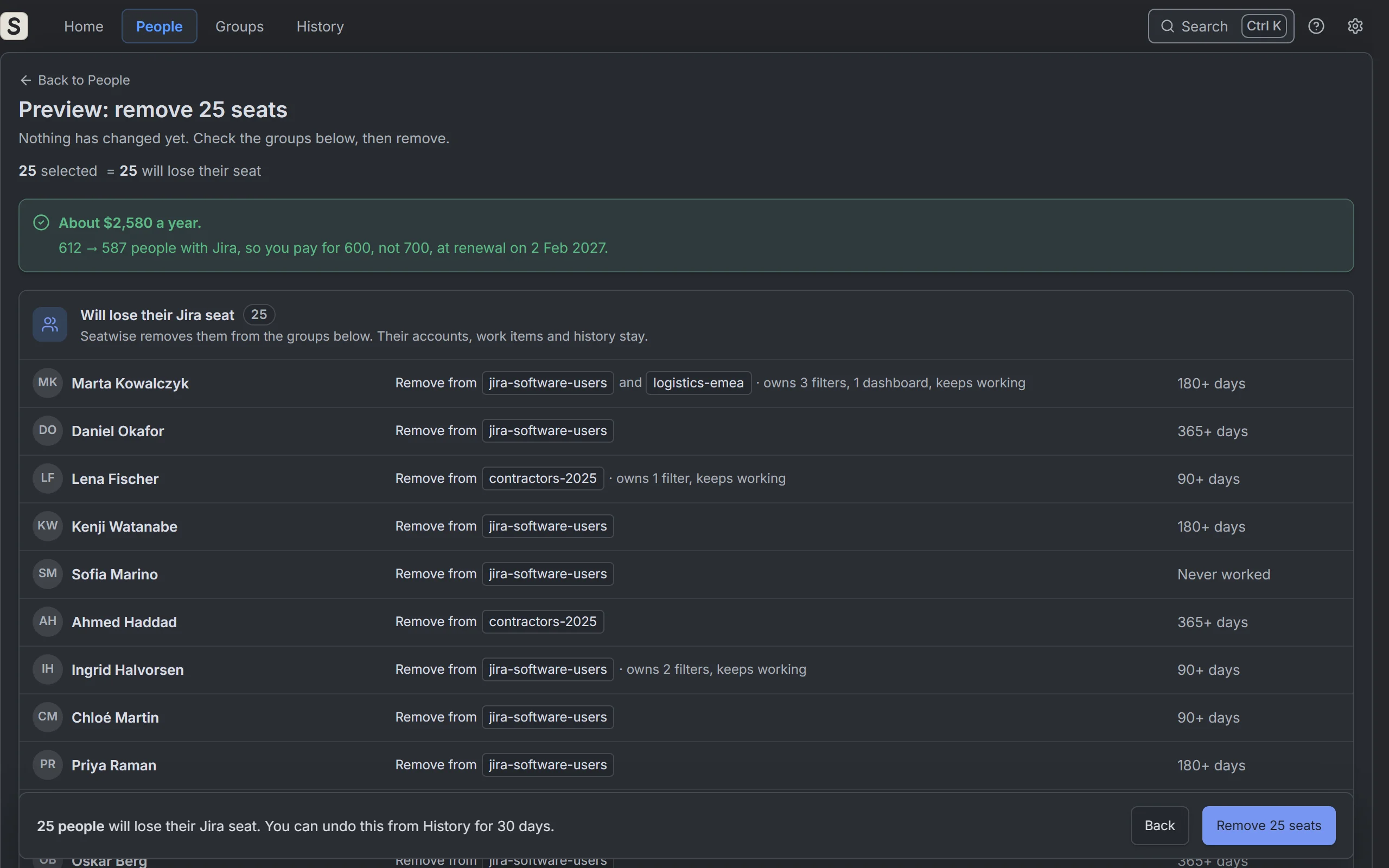
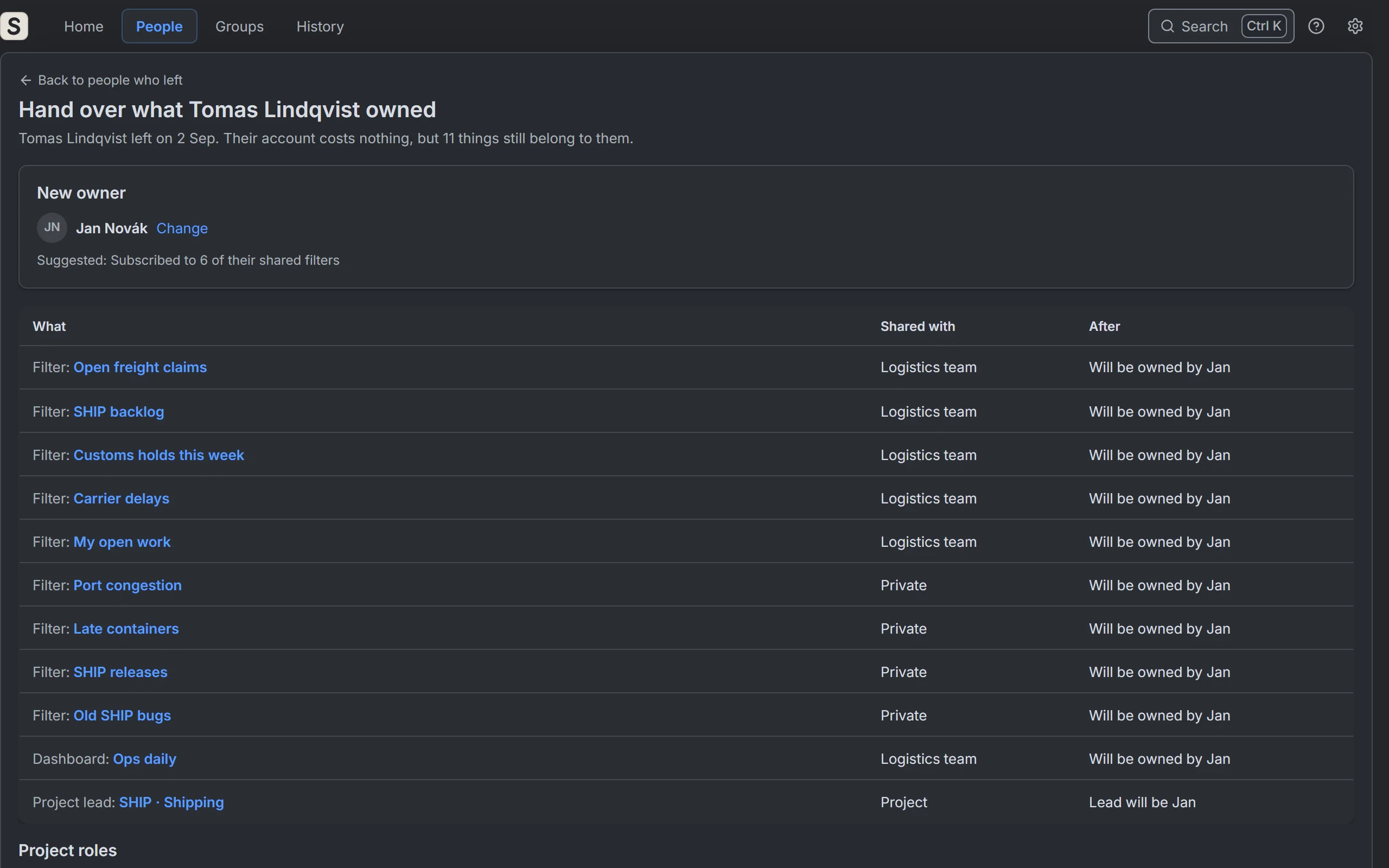
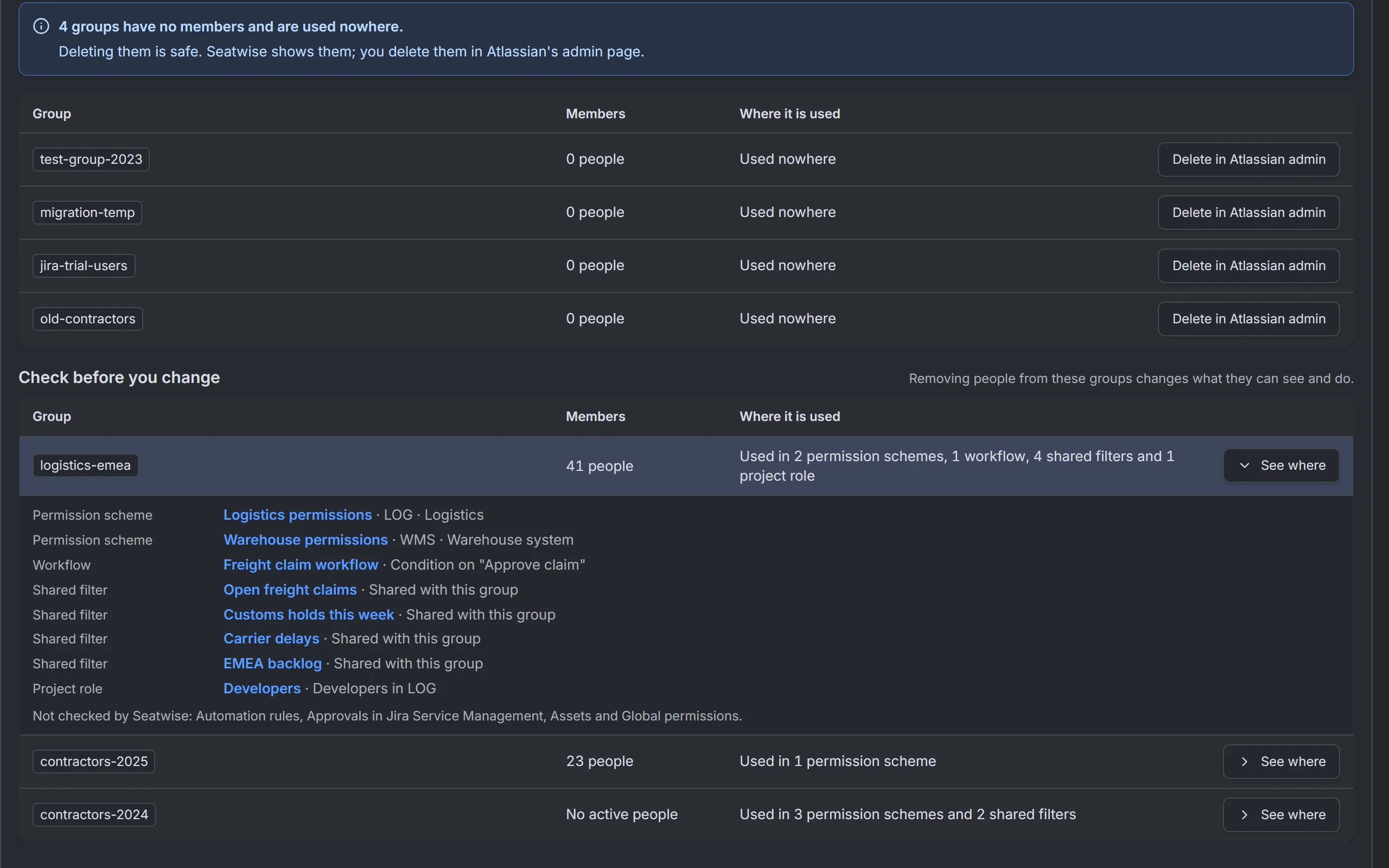
Use the product page for screenshots, pricing, scope boundaries, support, and the cleanest route into Marketplace.
Use the focused route when the buyer wants the commercial fit without reading the full article library first.
Inspect the proof model that keeps the cleanup explanation tied to the same cycle and decision batch.
Use the long-form article when the buyer still needs the hidden billable-access problem framed more clearly.
Use the Trust Center when the buyer wants product boundary, support, or legal confidence before trial.
Switch lanes if the real blocker is proving group impact, permission references, or rename/delete risk before a Jira change.