Unitlane logo Unitlane Governed Jira admin software
Comparison

An inactive-user list is not the same thing as a governed billable-access review.

Last-login filters are useful for finding candidates. They are weak when the team still has to explain why a row is billable, which rows belong in held-out lanes, and what proof should survive after cleanup.

Quick verdict

Inactive-user checks are fine for candidate discovery. They are weak when cleanup needs explanation, lanes, and proof.

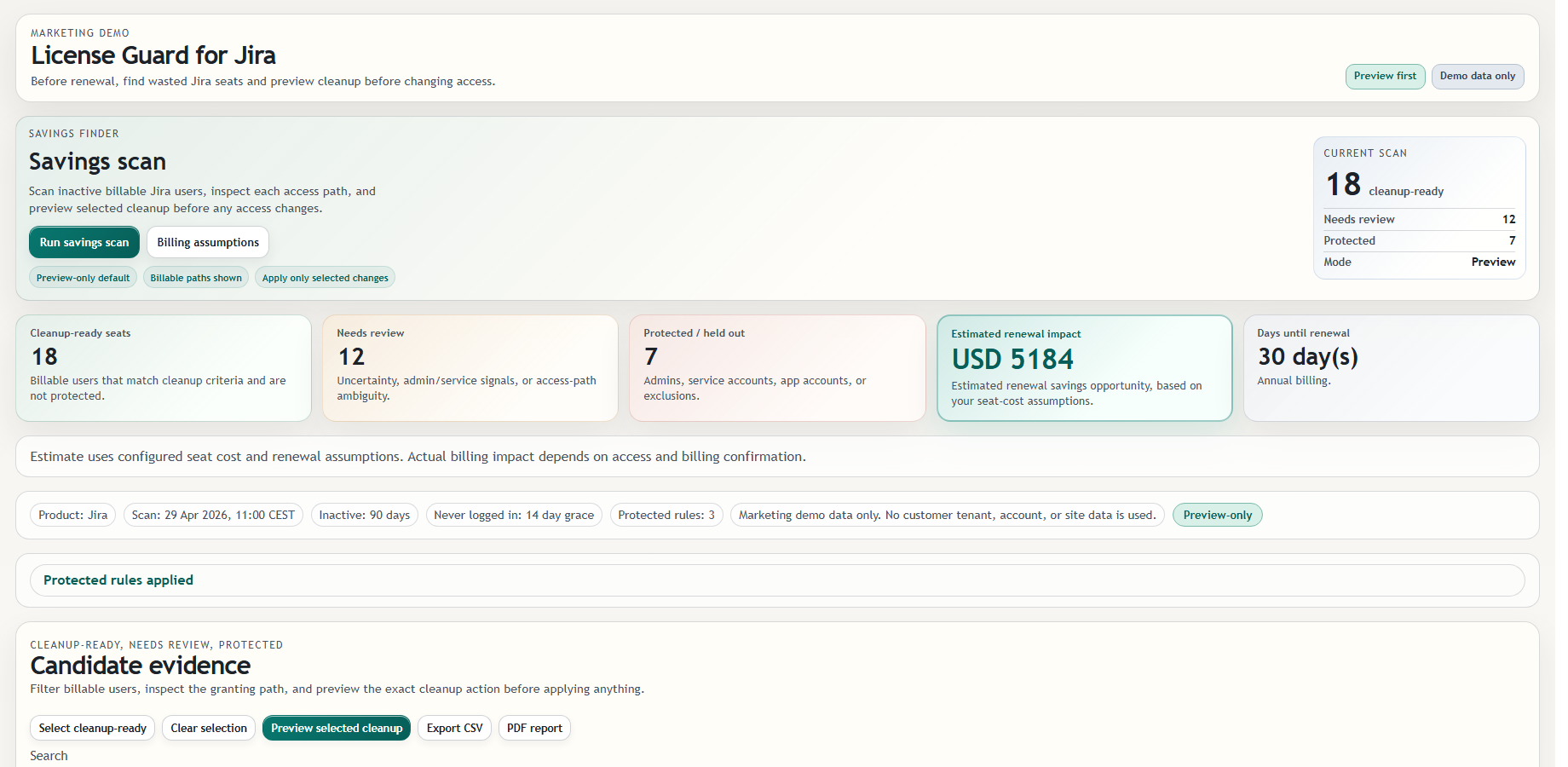
Last-login filtering is useful early. License Guard earns its place when the team has already found stale-looking rows but still cannot explain why each one is billable, which rows belong in held-out lanes, and what proof should survive after action.

Decision rule: use inactivity as a first-pass signal when one admin is triaging candidates. Move to License Guard when the real burden is billable-path explanation, exception handling, approval, and a cycle record someone else can trust later.

Continue evaluation
Question Inactive-user cleanup License Guard
What does the workflow really optimize for? Last activity or stale-user filtering Billable-path explanation and decision-ready cleanup
Can the team separate actionable humans from held-out rows? Usually with manual notes or tabs Yes, through explicit lanes and protected exceptions
Does inactivity prove the seat can be cleaned up now? No. It only creates a candidate list. No, but the workflow shows the billable path and next action more clearly
Can another reviewer approve the batch cleanly? Usually only after a live walkthrough Yes, because approval and proof stay attached to the same cycle
Does the review stay inside a narrow cleanup boundary? No defined boundary Yes. It is not SCIM, not IAM, and not account deletion
What survives after action? A list plus side notes A cycle record with lanes, approvals, and proof

When inactivity is enough

Early triage, small one-person cleanup passes, and situations where the team only needs a candidate list before a deeper review begins.

Where inactivity creates false confidence

Low activity can still mask a live billable path, a row that needs manager review, or an exception that should never enter the ordinary cleanup lane.

Billable path versus stale row

Inactivity is a symptom. The action decision still depends on which supported group or product path keeps the seat billable.

Who should use which

Use inactive-user filtering for discovery. Use License Guard when the team needs a reviewable cleanup workflow rather than another candidate list.

Lane-based review

Inactive users and actionable cleanup rows are not the same category.

The problem with inactivity-led cleanup is not that the signal is useless. The problem is that teams often let one signal define the whole review, even though the batch contains rows with very different next-step rules.

Row type How inactivity frames it Why that is not enough What a governed workflow adds
Clearly stale human Looks removable now The team still needs to explain which path keeps the row billable Billable-path explanation and approval-ready review
Needs owner confirmation Looks like another inactive account The row may still have a valid business owner or active exception Owner-review lane stays explicit
App or service identity Often looks stale or low-activity Non-human rows should not be processed like ordinary human cleanup Held-out exceptions stay visible
Externally managed row Still appears in the candidate list The local admin may not control the actual remediation path The review records route-out instead of pretending certainty
What people miss

Most inactive-user cleanup pain starts after the candidate list is already built.

The false comfort of inactivity-led cleanup is that the list feels concrete. The operational pain appears one step later, when approvers ask why the row is still billable, which rows were held out deliberately, and whether the savings claim will still make sense next month.

Failure mode What inactivity-led review usually does What a governed workflow changes
The row looks stale but no one can approve cleanup The team points at low activity instead of the billable path The review shows why the seat still costs money and what action fits
Exception rows keep stalling the whole batch Apps, service identities, and owner-review rows stay mixed together Held-out rows stay explicit instead of poisoning the human lane
Finance reopens the savings claim later The list survived, but the explanation did not Approval, lane logic, and proof stay tied to one cycle record
Teams confuse inactivity with lifecycle automation The review drifts into tooling claims it cannot actually prove The cleanup workflow stays narrow and more believable
Proof and sign-off

The expensive part is not finding stale-looking rows. It is defending the cleanup decision afterward.

Inactive-user lists are useful because they reduce the search space. They become weak when the team still needs to explain the billable path, keep owner-review rows separate, and preserve proof that survives after the cleanup cycle closes.

If the buyer still needs the cost argument framed more broadly first, the companion article The Hidden Cost of Inactive Users in Jira and Atlassian Cloud makes the case for why inactivity is only one slice of the waste model.

Diagram showing a recurring Jira access-review loop of scope, classify, review, approve, and preserve evidence.
What this is not

License Guard is not a better inactivity report. It is a narrower cleanup workflow.

This matters because plenty of buyers already have reporting, lifecycle tooling, or SCIM in place. The unresolved problem is still the review itself: explaining why the row is billable now, deciding whether it belongs in this cycle, and keeping proof after action. That is the slice this workflow is built to own.

The comparison gets clearer once the team respects that boundary. Inactive-user reporting is discovery. Governed billable-access review is decision support. Treating them as interchangeable usually creates weaker buying logic, weaker cleanup logic, and weaker trust.

FAQ

Questions teams usually ask before they move forward

Are inactive-user reports still useful?

Yes. They are useful for discovery and early triage. They are just not the same thing as a governed cleanup review.

Why doesn't inactivity tell the whole cleanup story?

Because low activity does not explain the billable path, the right lane for the row, or whether the row is safe to act on now.

What kinds of rows should be separated early?

Owner-review rows, app accounts, service identities, and externally managed rows should not be treated like ordinary human cleanup candidates.

When should a team move from inactivity checks to License Guard?

When the team already has candidate rows but still needs billable-path explanation, approval, exceptions, and proof tied to the same cycle.

Next routes

Use this page to move from stale-user thinking into billable-access review.

After the comparison, the next useful route is usually the product page, the renewal use case, the proof artifact, or the article that explains where waste actually comes from.